
Biosecurity Forecasting Group Updates - March 2025
Results from our trial version on H5N1, Marburg, Ebola, Mpox and other outbreaks.

This newsletter provides updates from the Biosecurity Forecasting Group (BFG) about the results of our forecasts to help stakeholders make informed decisions. We cover emerging outbreaks and key pathogens, offering expert commentary.
Want to get involved? We have rolling applications and opportunities for collaboration.
Keep reading for:
What is BFG?
Why are forecasts important for public health decision-makers?
Forecasting Updates
What’s next?
What is BFG?
Who are we, and what are the goals?
We aim to provide a credible source of evaluated forecasts, enabling stakeholders to understand likely outcomes, prioritise resources, and drive informed decision-making in biosecurity. We are running a trial version from 17th February to 19th May 2025.
Our forecasting group includes approximately 20 active contributors with expertise in virology, biosecurity, public health, and forecasting. This range of complementary skills helps us generate accurate, context-specific forecasts by combining domain knowledge with forecasting expertise.
What do we forecast?
During our MVP, we are forecasting the spread and impact of viral outbreaks. In particular:
H5N1
Marburg virus
Mpox
Ebola
Emerging outbreaks, e.g. the US measles outbreak
Beyond the MVP, we plan to forecast long-term trends in biosecurity innovation, the intersection of AI and biosecurity, potential policy changes, and other relevant developments. To learn more about our process, please refer to the “What types of questions does BFG focus on?” section below. Have a topic area or specific question that you think would be useful for us to forecast? Please suggest a forecast here.
I know someone who would be a good fit for this group. What should I do?
We have rolling applications which we review towards the beginning of every month. Please have them apply here.
Why are forecasts important for public health decision-makers?
What is a forecast, & Why is forecasting important for viral outbreaks?
A forecast is a structured prediction about future events based on data, trends, and probabilistic modelling. At BFG, forecasts are generated by analysing past and current data, along with expert insights from public health professionals who draw on their knowledge of disease patterns and transmission. Each forecaster makes their predictions and can submit comments explaining their methods and rationale. After a set period, everyone’s predictions become available to the group, allowing members to discuss and, if necessary, update their forecasts based on the new information.
Forecasting can be used by decision-makers to anticipate risks, allocate resources efficiently, and take proactive measures to mitigate viral outbreaks. It can provide early warnings and risk assessments, informing decisions on preparedness, resource distribution, and public health measures. Independent forecasts, such as those from BFG, offer unbiased perspectives that support more balanced, data-driven policy responses.
What types of questions does BFG focus on?
BFG focuses on two main types of questions - binary outcome questions and range-based questions.
Binary Outcome Questions
Binary outcome questions estimate the probability of a specific event occurring within a given timeframe. For example, a question might be asked, "What is the likelihood that H5N1 will cause more than five human deaths in the US by May 1, 2025?" Forecasters provide a probability, such as 20%, to reflect their assessment of the event’s likelihood based on available data and trends.
Here’s a visual representation of what 20% (1 in 5) probability looks like:
🟢 ⚫ ⚫ ⚫ ⚫
The green dot represents the predicted occurrence, while the black dots represent non-occurrences. This means that in one out of five possible worlds, H5N1 will cause more than five human deaths in the US by May 1, 2025, while in the other four, it will not. Forecasters provide a probability, such as 20%, to reflect their assessment of the event’s likelihood based on available data and trends.
Range Based Question
Range-based (bucketed) questions estimate numerical outcomes by assigning probabilities to non-overlapping predefined ranges (called ‘buckets’). For example, a question might be asked: "How many confirmed human cases of H5N1 will be reported in the US by January 1, 2026?" Forecasters distribute probabilities across the given buckets, such as 0-100 or 101-200 cases, ensuring they sum to 100% to reflect different possible outbreak trajectories.
Here’s an example of a range-based (bucketed) question with four probability buckets:
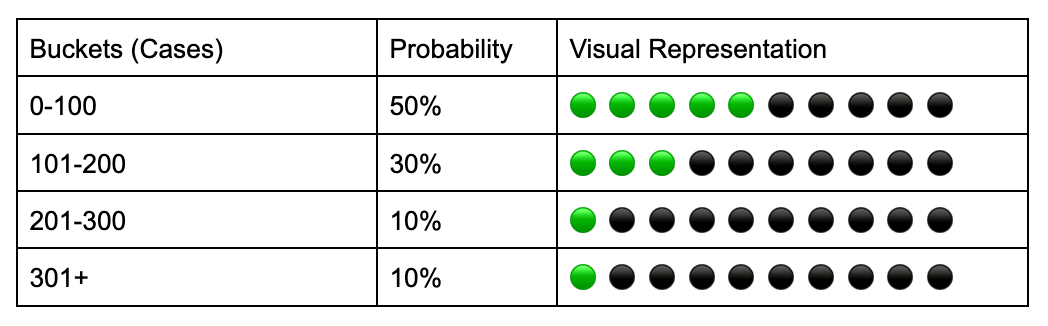
Each row represents a probability bucket, with green dots illustrating the likelihood assigned to that range and black dots representing the remaining uncertainty. This means that in 50 out of 100 possible worlds, the number of reported cases falls within 0-100, in 30 out of 100 worlds, it falls between 101-200, in 10 out of 100 worlds, it falls between 201-300, and in 10 out of 100 worlds, it exceeds 300 cases.

Forecasting Updates
In this section, we present the results of our forecasts for H5N1, Marburg Virus, Mpox, Ebola (including the Sudan outbreak) and the Mystery Outbreak in the Congo.
For each forecasting question, we give information about its resolution criteria, forecaster comments, community probability averages, notable anonymised forecaster comments (if applicable), and the final resolution. We also provide insights on how our predictions compared to real-world outcomes, highlighting key similarities, discrepancies, and lessons learned.
H5N1
H5N1, or avian influenza, is a subtype of the Influenza A virus that primarily affects birds but can also infect humans and other animals. The virus spreads through direct contact with infected birds or their droppings, and while human-to-human transmission is rare, it remains a public health concern. In the US, outbreaks have occurred in several states, with notable increases in cases beginning in September 2024. As of this date, there have been over 70 human cases, and over 1000 livestock herds have been affected. Understanding the spread of H5N1 is useful for preventing further transmission and mitigating potential risks to both human and animal populations.
Questions Forecasted
H5N1 (US) How many confirmed human cases of H5N1 will be reported in the US by February 28, 2025, according to the US dashboard?
Resolution criteria: The number of cases reported by the US dashboard as of February 28, 2025. The question was created on February 17th 2025.
Relevant links: https://public.tableau.com/app/profile/students.for.health.security.2024/viz/USH5N1OutbreakTracker/Dashboard1
Community probability averages:
70-100 cases: 97.7%
100-150 cases: 1.7%
150-200 cases: 0.2%
200+ cases: 0.3%
Forecaster comments: NA
Resolution: 70-100 cases (resolved)
Comparison to real-world outcome: The forecast was accurate, with the vast majority of forecasters correctly anticipating the case range.
Our takeaways: The majority of group members agreed on the outcome being in the 70 to 100 case range. This was confirmed by the real-world outcome as well.

H5N1 (US) How many confirmed human cases of H5N1 will be reported in the US by January 1st, 2026?
Resolution criteria: The number of cases reported by the US dashboard as of January 1st, 2026. The question was created on February 17th 2025.
Relevant links: https://public.tableau.com/app/profile/students.for.health.security.2024/viz/USH5N1OutbreakTracker/Dashboard1
Community probability averages:
70-100 cases: 6.6%
100-200 cases: 42.2%
200-300 cases: 33.7%
300+ cases: 6.7%
Forecaster comments: Unresolved
Resolution: Resolved on January 1st, 2026
Comparison to real-world outcome: TBD
Key takeaways: TBD

H5N1 (US) How many livestock herds will be affected by H5N1 in the US by February 28, 2025?
Resolution criteria: The number of affected livestock herds reported by the US dashboard as of February 28, 2025. The question was created on February 17th 2025.
Relevant links: https://public.tableau.com/app/profile/students.for.health.security.2024/viz/USH5N1OutbreakTracker/Dashboard1
Community probability averages:
970–1000: 90.2%
1000–1100: 4.4%
1100–1200: 2.5%
1200+: 0.4%
Forecaster comments: NA
Resolution: 970–1000 (resolved)
Comparison to real-world outcome: The forecast was highly accurate, with the majority correctly identifying the 970–1000 range.
Key takeaways: The group had a strong consensus that the outcome would be within the 970-1000 case range. This was confirmed by the real-world outcome as well. There was little discussion about this question.

H5N1 (US) How many US states will have reported human cases of H5N1 by February 28, 2025?
Resolution criteria: The number of individual US states with reported human H5N1 cases as indicated on the official US dashboard as of February 28, 2025. The question was created on February 17th 2025.
Relevant links: https://public.tableau.com/app/profile/students.for.health.security.2024/viz/USH5N1OutbreakTracker/Dashboard1
Community probability averages:
10–15: 66.5%
15–20: 12.5%
20–25: 0.5%
25+: 0.3%
Forecaster comments: “for future questions, ambiguity can be resolved by adding 'confirmed or probable’ to the question resolution criteria”
Resolution: Ambiguous
Comparison to real-world outcome: The underlying data suggested 15 states had reported cases on February 28th, which fell into overlapping buckets (10–15 and 15–20), making it impossible to resolve cleanly.
Key takeaways: Ambiguity in resolution arose due to overlapping bucket boundaries. Forecasters noted that 15 fit into both the 10–15 and 15–20 ranges, creating confusion. Some forecasters used CDC sources that listed probable vs confirmed cases inconsistently. Ultimately, the group agreed that the question should be resolved as ambiguous. This underscores the need for clearly non-overlapping buckets (10-15 and 16-20) and explicit criteria (e.g., “confirmed and/or probable”) in future questions.

H5N1 (US) What is the likelihood that H5N1 will cause 5 or more human deaths in the US by May 1st, 2025? Resolves YES if it is confirmed by a credible news source.
Resolution criteria: If 5 or more total human deaths from H5N1 in the US are reported by May 1st, 2025, and confirmed by a credible news source. The question was created on February 17th 2025.
Relevant links: https://public.tableau.com/app/profile/students.for.health.security.2024/viz/USH5N1OutbreakTracker/Dashboard1
Community probability averages:
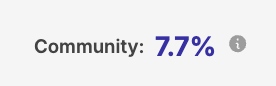
YES: 7.7%
5 or more deaths (resolves YES) = 7.7%
4 or fewer deaths (resolves NO) = 92.3%
Forecaster comments:
Five forecasters expressed strong scepticism that the US would see 5 additional deaths by May 1st, given that only 1 had occurred so far. Two high forecasts (e.g. 63% and 80%) assumed exponential case/death growth but were later revised downward due to the lack of follow-up reports. One forecaster noted that 15% of responses had forecasts above 25% and questioned their rationale. Overall, following the discussion, sentiment leaned toward low probability, citing current trends and confirmed data.Resolution: TBD
Comparison to real-world outcome: TBD
Key takeaways: TBD
Marburg Virus Disease
Marburg virus disease is a rare viral hemorrhagic fever caused by the Marburg or Ravn virus, affecting humans and primates with severe symptoms like fever, rash, and bleeding. It spreads primarily through contact with infected animals, particularly Egyptian rousette bats, and is most commonly found in sub-Saharan Africa. Outbreaks in these regions pose a significant public health risk due to high mortality rates (with case-fatality rates reported to be up to 90%) and limited healthcare resources. Forecasting Marburg is useful for early detection, guiding interventions, and preventing future outbreaks.
Questions Forecasted
Marburg Virus (World) What is the probability of a new virus outbreak before May 1st, 2025? Resolves YES if there are greater than or equal to 5 cases that are confirmed by a credible source, eg WHO, Africa CDC.
Resolution criteria: A new Marburg virus outbreak is confirmed if ≥5 human cases are reported before May 1st, 2025, and verified by a credible source such as WHO or Africa CDC. This question was created on February 24th, 2025.
Relevant links: https://www.who.int/news-room/fact-sheets/detail/marburg-virus-disease
Community probability averages:
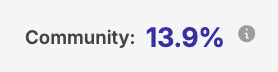
Before new info: 17.0%
After new information about bat birth patterns: 13.9%
Forecaster comments: Some forecasters referenced the seasonal spillover pattern tied to Egyptian Rousette bats, which give birth in pulses around June–September and December–March. These birth events increase juvenile bat populations and with them, the likelihood of MARV spillover to humans. Since we are exiting a high-risk period, many considered another outbreak unlikely before May, though not impossible.
Resolution: TBD
Comparison to real-world outcome: TBD
Key takeaways: Forecast revisions suggest forecasters took seasonality and reservoir ecology into account. Knowledge of MARV transmission dynamics appears to have reduced perceived short-term risk.
Mpox
Mpox, formerly known as monkeypox, is a viral disease caused by the Mpox virus, which belongs to the Orthopoxvirus genus. It primarily affects animals, but it can also be transmitted to humans through direct contact with infected animals, bodily fluids, or contaminated materials. The disease causes symptoms similar to smallpox, such as fever, rash, and swollen lymph nodes. The case-fatality ratio (CFR) of Mpox varies, ranging from 1% to 10% depending on the strain. Since 2023, there have been ongoing outbreaks of clade I mpox, which has a CFR of around 3%, with recent cases from Uganda, the Democratic Republic of Congo (DRC), Burundi, and the Central African Republic (CAF). Forecasting Mpox is useful for early detection of outbreaks and preventing further spread.
Questions Forecasted
Mpox (World) How many confirmed cumulative Mpox cases will be reported globally by February 28, 2025? Resolves according to the OWID Mpox dashboard.
Resolution criteria: The question resolves based on the cumulative number of confirmed Mpox cases shown under Region: World, Metric: Confirmed cases, and Frequency: Cumulative on the OWID Mpox dashboard as of February 28, 2025. This question was created on February 24th, 2025.
Relevant links: https://ourworldindata.org/mpox
Community probability averages:
124,831–126,000: 35%
126,001–128,500: 37.3%
128,501–131,000: 0.6%
131,001+: 0.1%
Forecaster comments: NA
Resolution: 126,001–128,500 (resolved)
Comparison to real-world outcome: The final case count was 126,441, falling in the 126,001–128,500 range. While most forecasters initially predicted a lower bracket (124,831–126,000), many later shifted toward the correct range as updated case data became available.
Key takeaways: Community adjustment over time demonstrated responsiveness to new data. Previously, the community was squeiwing more heavily towards the lower range bucket. The relatively even split between the top two brackets in final forecasts shows how close the outcome was to the boundary between bins one and two, highlighting the importance of precision in both forecasting and bin selection.

Mpox (World) How many confirmed cumulative Mpox cases will be reported globally by May 1st, 2025? Resolves according to the OWID Mpox dashboard.
Resolution criteria: The question resolves based on the cumulative number of confirmed Mpox cases shown under Region: World, Metric: Confirmed cases, and Frequency: Cumulative on the OWID Mpox dashboard as of May 1st, 2025. This question was created on February 24th, 2025.
Relevant links: https://ourworldindata.org/mpox
Community probability averages:
124,831–126,000: 1.9%
126,001–128,500: 7.1%
128,501–131,000: 22.7%
131,001+: 27.6%
Forecaster comments:
Forecasters noted that much of the recent Mpox activity is concentrated in the DRC, particularly in areas under rebel control (e.g. South and North Kivu). There is concern that case underreporting may occur due to disrupted healthcare infrastructure, looted treatment centres, and mass displacement. A BBC report highlighted deteriorating conditions, with large numbers of displaced individuals potentially carrying the virus to new locations.Resolution: TBD
Comparison to real-world outcome: TBD
Key takeaways: Forecasts are influenced by both epidemiological factors and reporting conditions. The spread of Mpox in conflict zones may drive up actual case numbers, but disruptions to surveillance and health services could limit reported totals.

Ebola
Ebola is a highly contagious and often fatal viral hemorrhagic fever caused by the Ebola virus. It spreads through direct contact with infected bodily fluids, such as blood, saliva, and vomit, and can cause symptoms like fever, bleeding, and organ failure. Four distinct virus species are pathogenic to humans: Zaire ebolavirus, Bundibugyo ebolavirus, Taï Forest ebolavirus, and Sudan ebolavirus. The case-fatality rate (CFR) for Ebola overall is around 60% but varies significantly depending on the virus species that causes it and is higher in sub-Saharan Africa than in the rest of the world. Zaire ebolavirus is the most lethal (CFR = 66.6%), followed by Sudan ebolavirus (CFR = 48.5%), Bundibugyo ebolavirus (CFR = 32.8%), and Taï Forest virus (CFR = 0%). There have been 38 outbreaks from 1976 to 2020. Given its high fatality rate, forecasting Ebola is useful for early intervention, controlling outbreaks, and improving public health responses.
Questions Forecasted
Ebola (World) How many confirmed Ebola hemorrhagic fever cases will be reported globally from January 1st, 2025, to May 1st, 2025? Resolves according to the Africa CDC page.
Resolution criteria: The number of confirmed Ebola hemorrhagic fever cases globally reported between January 1st and May 1st, 2025, as listed in either the Africa CDC weekly outbreak briefings, the Africa CDC epidemic intelligence reports, or the WHO AFRO emergency updates. The general Africa CDC Ebola page is excluded due to being outdated. This question was created on February 24th, 2025.
Relevant links:
Community probability averages:
0–1: 0.2%
2–5: 0.6%
6–10: 1.7%
11+: 96.8%
Forecaster comments: As of March 12th, there have been 12 confirmed cases in Uganda. Three forecasters expect there to be more cases due to a reporting delay.
Resolution: 11+
Comparison to real-world outcome: 12 confirmed cases in Uganda.
Key takeaways: Forecasts reflect both current case data and expectations of current underreporting or future spread.

Sudan Virus Disease (Uganda) How many confirmed cases of Sudan virus disease (SVD) will be reported to the WHO by June 30, 2025, since the Uganda outbreak was declared on January 30, 2025? The question will be resolved using the first Disease Outbreak News report from the WHO dated on or after July 15, 2025.
Resolution criteria: Number of confirmed SVD cases reported in the first WHO DON after July 15, 2025. This question was created on March 12th, 2025.
Relevant links: https://www.who.int/emergencies/emergency-events/item/2025-e000053
Community probability averages:
9–15: 9.8%
16–20: 8.9%
21–25: 13.1%
26–30: 4%
30+: 7.7%
Forecaster comments: NA
Resolution: TBD
Comparison to real-world outcome: TBD
Key takeaways: TBD

Mystery Outbreak
An outbreak of acute febrile illness of unknown origin is ongoing in Équateur Province, Democratic Republic of the Congo, affecting the Basankusu and Bolomba Health Zones. As of 19 February 2025, a total of 955 suspected cases and 60 deaths (CFR 6.3%) have been reported. Most cases are from Basankusu (943 cases, 52 deaths; CFR 5.5%), with infections recorded between 9 and 19 February. In Bolomba, 12 cases and 8 deaths (CFR 66.7%) were reported earlier between 10 and 27 January, mostly among children under five. Over half of the individuals tested in Basankusu were positive for malaria, but other causes such as meningitis, typhoid, and water or food contamination remain under investigation. No epidemiological link has been confirmed between the two clusters. WHO and national teams continue to investigate the source and coordinate response efforts in both areas.
Questions Forecasted
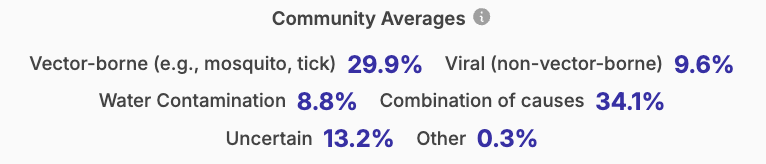
Mystery Outbreak (Congo) What is the most likely cause of the current Congo outbreak? As we know best on March 31st. [Please write a comment for your rationale]
Resolution criteria: The cause will be judged most likely based on the evidence available by March 31, 2025.
Relevant links:
Community probability averages:
Vector-borne (e.g., mosquito, tick): 29.9%
Viral (non-vector-borne): 9.6%
Water contamination: 8.8%
Combination of causes: 34.1%
Uncertain: 13.2%
Other: 0.3%
Forecaster comments: One forecaster noted that the January and February outbreaks are likely unrelated and specified they would focus their forecast on the February cluster, which has been speculated to result from chemical poisoning or rapid-onset bacterial meningitis. Another forecaster noted that cases have tested positive for malaria, indicating a likely vector-borne component. However, they added that the possibility of a waterborne or rapid-onset cause has also been raised, and the combination of these factors, along with malnutrition, suggests multiple contributing causes to the outbreak. One forecaster suggested that the link to contaminated water could indicate either direct poisoning or mosquito exposure near water sources. They also mentioned the eaten bat carcass as a possible sign of environmental contamination, noting they would expect other dead animals in the same water. One forecaster noted that malaria has been confirmed as a cause of the outbreak, at least in part, referencing a news report. However, another forecaster cautioned that the source is relatively weak and not definitive on its own.
Resolution: TBD
Comparison to real-world outcome: TBD
Key takeaways: TBD
Measles
Measles is a highly contagious viral infection that causes symptoms such as fever, cough, and a characteristic red, blotchy rash. It spreads through respiratory droplets when an infected person coughs or sneezes. Despite being preventable by vaccination, measles continues to cause outbreaks globally, particularly in regions with low vaccination coverage. As of April 3rd, 2025, a total of 607 confirmed measles cases have been reported in the US in 2025. Forecasting measles is useful for tracking potential outbreaks.
Stay tuned for our forecasts on these questions!
What’s Next?
Over the next few months, we will continue to forecast similar types of questions and train our group members to improve their forecasting abilities. We are also working on building a dashboard for our forecasts like Birdflurisk.com.
If you have suggestions for questions that we should forecast, please submit them here. If you want to get involved as a forecaster, please apply here. If you are interested in collaborating or partnering with us, please fill in this form or email us at forecasting@oxfordbiosecuritygroup.com.
You can subscribe for future updates below.
We are always looking for ways to make this group better. If you have feedback or suggestions for improvements, please let us know by filling in this (optionally anonymous) form or emailing us at forecasting@oxfordbiosecuritygroup.com.